
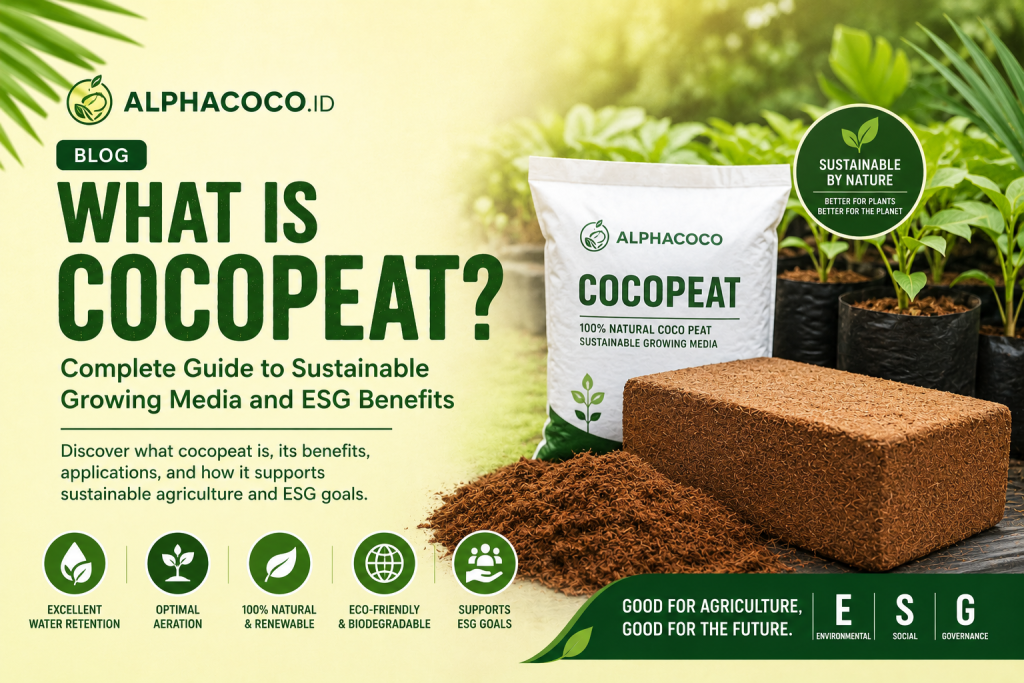
What is Cocopeat? Complete Guide to Sustainable Growing Media and ESG Benefits
Cocopeat has become one of the fastest-growing sustainable agricultural materials in the global horticulture industry. As demand for eco-friendly farming and ESG-driven products continues to rise, cocopeat is increasingly recognized as a premium alternative to traditional soil and peat moss.
At AlphaCoco, we provide high-quality cocopeat products from Indonesia to support agriculture, hydroponics, horticulture, and sustainable industrial applications worldwide.
What is Cocopeat?
Cocopeat, also known as coir pith or coconut peat, is a natural growing medium made from processed coconut husk powder. It is produced as a byproduct during the extraction of coco fiber from coconut husks.
Previously considered agricultural waste, coconut husks are now transformed into highly valuable eco-friendly products used in modern agriculture and horticulture industries.
Cocopeat is widely known for its:
- Excellent water retention
- High aeration capability
- Eco-friendly composition
- Sustainable sourcing
- Lightweight structure
- Biodegradable properties
Because of these advantages, cocopeat has become one of the most preferred growing media for professional growers and hydroponic farming systems worldwide.
How Cocopeat is Made
The cocopeat production process involves several stages:
1. Coconut Husk Collection
Mature coconut husks are collected from coconut processing industries.
2. Fiber Extraction
The husks are processed to separate coco fiber and cocopeat.
3. Washing Process
The cocopeat is washed to reduce salt content and improve quality.
4. Drying & Screening
The material is dried and filtered to achieve uniform particle size.
5. Compression & Packaging
Cocopeat is compressed into blocks, briquettes, grow bags, or bales for export and commercial use.
At AlphaCoco Indonesia, we prioritize quality control to ensure stable EC levels, low impurities, and export-grade cocopeat products.
Main Benefits of Cocopeat
1. Excellent Water Retention
Cocopeat can retain water up to 8–10 times its weight, making it highly efficient for agriculture and hydroponics.
This helps:
- Reduce water consumption
- Maintain soil moisture
- Improve irrigation efficiency
2. Superior Aeration
The porous structure of cocopeat allows roots to receive better oxygen circulation.
Benefits include:
- Faster root development
- Healthier plant growth
- Reduced root rot risk
3. Eco-Friendly & Sustainable
Unlike peat moss, which is harvested from natural peat bogs, cocopeat utilizes renewable coconut waste materials.
This makes cocopeat:
- Environmentally friendly
- Renewable
- Biodegradable
- Sustainable for long-term agricultural use
4. Lightweight and Easy to Transport
Compressed cocopeat blocks are lightweight and space-efficient, making them ideal for global export and commercial distribution.
5. Low Risk of Soil Diseases
High-quality washed cocopeat contains fewer pathogens and contaminants compared to conventional soil.
This supports cleaner and healthier cultivation systems.
Cocopeat Applications
Hydroponics
Cocopeat is one of the most popular growing media for hydroponic farming systems because it balances moisture retention and oxygen availability.
Suitable for:
- Tomatoes
- Lettuce
- Cucumbers
- Strawberries
- Peppers
- Cannabis cultivation markets (where legally permitted)
Greenhouse Farming
Commercial greenhouse operators use cocopeat to improve crop consistency and irrigation control.
Horticulture & Nurseries
Cocopeat supports:
- Seed germination
- Plant propagation
- Ornamental plants
- Flower cultivation
Soil Conditioning
Cocopeat improves soil structure by:
- Increasing moisture retention
- Enhancing aeration
- Supporting microbial activity
Home Gardening
Cocopeat is also widely used in urban gardening and indoor plant cultivation because of its clean and lightweight properties.
Low EC vs High EC Cocopeat
Understanding EC (Electrical Conductivity) is important in the cocopeat industry.
Low EC Cocopeat
Low EC cocopeat contains lower salt levels and is preferred for:
- Hydroponics
- Sensitive crops
- Professional agriculture
High EC Cocopeat
High EC cocopeat may still contain natural salts and is commonly used for:
- General landscaping
- Soil improvement
- Non-sensitive plants
At AlphaCoco Official Website, we provide both Low EC and customized cocopeat specifications based on buyer requirements.
Cocopeat and ESG Sustainability
As global companies adopt ESG (Environmental, Social, and Governance) standards, cocopeat has become an increasingly important sustainable material.
Environmental Benefits (E)
Reducing Coconut Waste
Millions of coconut husks are discarded annually. Cocopeat production transforms agricultural waste into valuable products.
Sustainable Alternative to Peat Moss
Peat moss extraction damages natural peatland ecosystems and releases carbon emissions.
Cocopeat provides a renewable and more sustainable alternative.
Lower Environmental Impact
Cocopeat production generally has a lower environmental footprint compared to synthetic growing media.
Social Impact (S)
The cocopeat industry supports rural communities and local economies by creating jobs in:
- Coconut farming
- Processing facilities
- Packaging
- Logistics
- Export operations
Indonesia’s coconut industry has significant potential to improve rural economic development through value-added coconut products.
Governance & Responsible Supply Chain (G)
International buyers increasingly require:
- Sustainable sourcing
- Product traceability
- Responsible manufacturing
- Stable export quality
At AlphaCoco Sustainable Products, we are committed to responsible sourcing, quality consistency, and long-term global partnerships.
Why Global Buyers Choose Indonesian Cocopeat
Indonesia is one of the world’s largest coconut-producing countries, making it a strategic source for premium cocopeat products.
Global buyers prefer Indonesian cocopeat because of:
- Abundant raw materials
- Competitive pricing
- Export scalability
- Sustainable sourcing potential
- High-quality tropical coconut resources
Cocopeat vs Peat Moss
| Feature | Cocopeat | Peat Moss |
|---|---|---|
| Renewable | Yes | No |
| Eco-Friendly | Yes | Limited |
| Water Retention | Excellent | Excellent |
| Aeration | Excellent | Moderate |
| Sustainability | High | Low |
| Biodegradable | Yes | Yes |
As sustainability becomes more important globally, many growers are transitioning from peat moss to cocopeat.
Why Choose AlphaCoco?
At AlphaCoco Indonesia Official Website, we supply export-quality cocopeat products for international agriculture and horticulture markets.
Our advantages include:
- Premium Indonesian raw materials
- Custom specifications
- Low EC cocopeat
- Export-ready production
- Sustainable sourcing
- ESG-oriented supply chain
We are committed to supporting global agriculture with eco-friendly coconut-based solutions.
Frequently Asked Questions (FAQ)
What is cocopeat used for?
Cocopeat is used for hydroponics, agriculture, greenhouse farming, horticulture, soil conditioning, and gardening applications.
Is cocopeat environmentally friendly?
Yes. Cocopeat is a renewable and biodegradable material made from coconut husk waste.
Why is cocopeat better than peat moss?
Cocopeat is considered more sustainable because it comes from renewable coconut resources and helps reduce agricultural waste.
Is cocopeat good for hydroponics?
Yes. Cocopeat offers excellent water retention and root aeration, making it ideal for hydroponic cultivation.
Can cocopeat be reused?
Yes. High-quality cocopeat can often be reused after proper cleaning and treatment.
AlphaCoco
Turning Coconut Waste into Sustainable Global Solutions