
Cocopeat Low EC: Washed vs. Unwashed – What’s the Difference and Why It Matters
Cocopeat, also known as coir pith, is one of the most popular growing media in modern agriculture and horticulture. It is derived from the husk of coconuts and has gained recognition worldwide due to its excellent water retention, aeration, and sustainability.
However, not all cocopeat is the same. One of the key specifications buyers look for is EC (Electrical Conductivity), which indicates the salt content in the material. Based on this, cocopeat is generally classified into Washed (Low EC) and Unwashed (High EC).
So, what is the difference, and how does it impact plant growth? Let’s break it down.
What is EC in Cocopeat?
EC (Electrical Conductivity) measures the level of soluble salts in cocopeat.
It is expressed in mS/cm (milliSiemens per centimeter).
High EC cocopeat has higher salt content, while Low EC cocopeat has been processed to reduce these salts, making it safer for sensitive crops.
Washed Cocopeat (Low EC)
Definition:
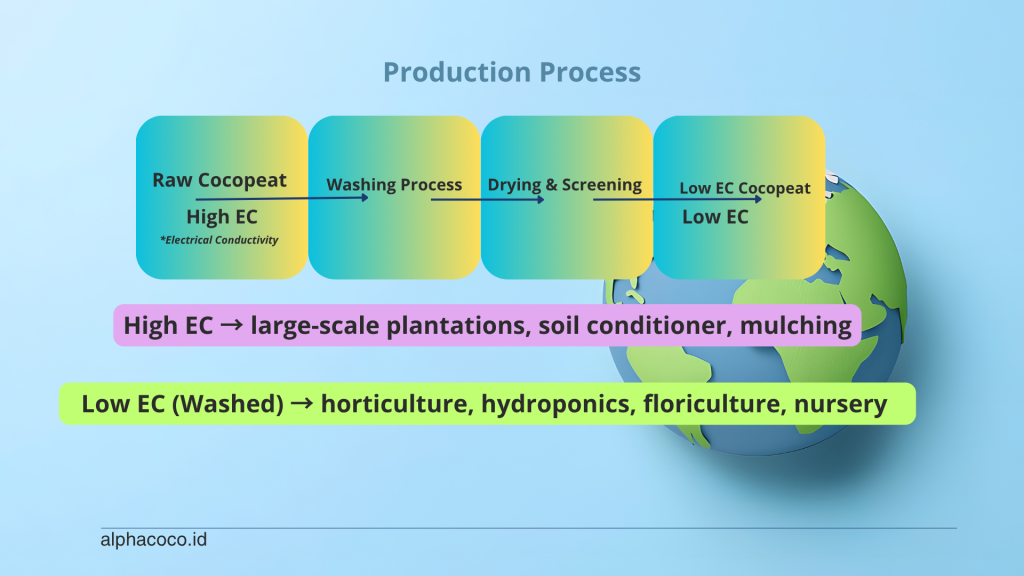
Washed cocopeat is cocopeat that has undergone a thorough washing process using fresh water to reduce the level of salts. After washing, it is dried and screened to achieve uniform quality.
Typical EC Level:
Less than 0.6 mS/cm
Benefits:
Safe for Sensitive Plants – Ideal for horticulture, hydroponics, floriculture, and nurseries where excess salts can damage young roots.
Stable Growing Medium – Allows farmers to fully control nutrient levels without interference from natural salts.
Better Root Development – Low EC promotes healthy root growth, stronger seedlings, and higher yields.
Cleaner and More Consistent – Washed cocopeat is usually free from excess dust and tannins, making it easier to handle and mix with other substrates.
Common Uses:
Hydroponic farming
Greenhouse cultivation
Vegetable and fruit nurseries
Flower cultivation
Unwashed Cocopeat (High EC)
Definition:
Unwashed cocopeat is raw cocopeat that has not undergone the washing process. It naturally contains higher levels of sodium, potassium, and chloride due to the coconut’s growing environment.Typical EC Level:
More than 1.0 – 2.0 mS/cm
Benefits:
Cost-Effective Option – Cheaper compared to washed cocopeat, making it suitable for large-scale applications.
Soil Conditioner – Improves soil aeration, structure, and water-holding capacity in agricultural fields.
Suitable for Hardy Crops – Can be used for crops less sensitive to salts, such as oil palm, coffee, and rubber.
Mulching Material – Effective as a natural mulch to retain soil moisture, suppress weeds, and reduce erosion.
Common Uses:
Plantations (oil palm, coffee, rubber, cocoa, sugarcane)
Large-scale soil improvement
Mulching and landscaping
Animal bedding or biomass fuel (alternative usage)
Choosing between Washed (Low EC) cocopeat and Unwashed (High EC) cocopeat depends on the application.
If you are growing vegetables, flowers, or seedlings, Low EC washed cocopeat is the best choice for safety and consistency.
If you are working on plantations, soil improvement, or mulching, High EC unwashed cocopeat is a more economical option.
By understanding the difference, buyers and farmers can make the right decision to maximize crop health, yield, and cost efficiency.
Feature Washed Cocopeat (Low EC) Unwashed Cocopeat (High EC) EC Level <0.6 mS/cm >1.0 – 2.0 mS/cm Salt Content Low (safe for sensitive crops) High (can harm delicate roots) Price Higher Lower Main Use Horticulture, hydroponics, nursery, floriculture Plantations, soil conditioner, mulching Quality Clean, uniform, ready to use Raw, may require treatment before sensitive use
Great article!
Hey Thanks…